


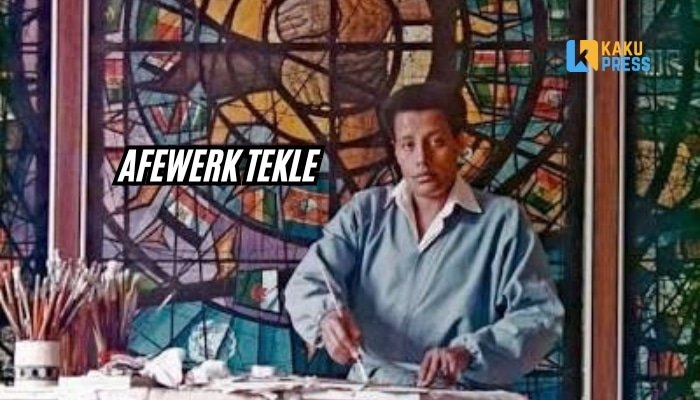
Search for Afewerk Tekle and you get old interviews, clashing dates and no clear answer on where his art is today. That’s frustrating when you just want the facts.
This guide gives them to you straight. You’ll get his life, his best-known works and his awards. You’ll also get the update most pages skip: his 150-square-meter Africa Hall window was restored and unveiled again in 2024.
Who was Afewerk Tekle?
Afewerk Tekle (1932 to 2012) was an Ethiopian painter, muralist and stained glass artist. He is best known for The Total Liberation of Africa, a 150-square-meter window in Addis Ababa’s Africa Hall. He studied in London, held Ethiopia’s first major modern art show in 1954, and became one of Africa’s most honored artists.
Think of him as Ethiopia’s first modern art star. Before 1954, Addis Ababa had not seen a show like his. After it, young artists had a path to follow.
His style mixed Ethiopian church art, African pride and European training. Historian Richard Pankhurst found in a 1990s interview that younger artists wanted to become “the next Afewerk.” That tells you how big his shadow was.
How did a mining student become a world-famous artist?
Afewerk Tekle was born on 22 October 1932 in Ankober, in Shewa Province. His parents were Tekle Mamo and Feleketch Yamatawork. He grew up during the Italian occupation.
In 1947, after the war, he went to England to study mining engineering. The goal was to help rebuild Ethiopia. Art won out. He moved to the Central School of Arts and Crafts in London, then to the Slade School of Art, where he studied painting, sculpture and architecture.
One Ethiopian government summary calls him the first African student at the Slade. I couldn’t confirm that in a second source, so treat it with care.
Why did his first art show in 1954 cause a storm?
He came home in 1954 and held a one-man show at Municipality Hall in Addis Ababa. Art historians call it the first significant modern art exhibition in Ethiopia. It also included abstract paintings, which was new for the country.
Church leaders were angry. His Crucifixion broke sharply from traditional Ethiopian church painting. The press was harsh. At first, he sold nothing.
Then Emperor Haile Selassie bought two paintings and urged other well-off people to buy. Seven more went to buyers who never paid. The emperor told them to pay or return the works. All seven came back.
The show still paid off. The money funded about two years of study in Europe. He learned to design and build stained glass. He also studied Ethiopian illustrated manuscripts in the British Library, the Bibliothèque Nationale in Paris and the Vatican Library.
What is “The Total Liberation of Africa,” and what does it show?
It’s his most famous work. He designed it in 1958, and it was inaugurated in 1961. The window covers 150 square meters and sits in the foyer of Africa Hall, home of the UN Economic Commission for Africa.
It has three parts: Africa Then, Africa Then and Now, and Africa Now and in the Future. The story moves from the sorrow of the past to struggle in the present to hope ahead. One scene shows a knight wearing the UN logo, a dragon and the grim reaper. The project architect who worked on the 2024 restoration read it as a tale of slaying the demons of colonial rule.
The setting matters too. Two years after the hall opened, leaders from 33 African states signed the Organisation of African Unity charter under that glass. Today the image shows up on shirts and ties around Addis Ababa.
What happened to the Africa Hall window in 2024?
Africa Hall was re-inaugurated in October 2024 after years of renovation. UN Secretary-General António Guterres and Ethiopian Prime Minister Abiy Ahmed attended. The building now has a visitors’ center and a permanent exhibition space.
The window got its own project. Crews took it apart, cleaned it and rebuilt it panel by panel. The work was led by Emmanuel Thomas, grandson of the man who made the original glass from Tekle’s design at the Valence workshop in France. Portugal made a voluntary contribution to the restoration.
Reports use different words. Most say “restored.” One architecture report says the glass was “fully replicated.” So how much original glass remains is unclear. If you plan to visit, ask the Economic Commission for Africa about access first.
Which Afewerk Tekle artworks should you know first?
Here are the pieces that come up most in museum notes and official tributes.
| Work | Year | Where | What to know |
|---|---|---|---|
| Maskal Flower | 1961 | Shown in Russia, the US and Senegal | Debuted at his Addis Ababa retrospective, then traveled |
| The Total Liberation of Africa | Designed 1958, opened 1961 | Africa Hall, Addis Ababa | Three-part, 150 sq m window |
| Altar cross | 1959 | Royal Chapel, Tower of London | One of his best-known works abroad |
| The Last Judgment | 1970 | Adigrat Cathedral, Tigray | Church mural |
| Unity Triptych | 1977 | Algiers International Festival | Won the gold medal |
| The Victory of Ethiopia | 1979 | Hero Centre, Debre Zeit | Large commemorative work |
| The Chalice and the Cross in the Life of the African People | 1997 | Biennale of Aquitaine, France | Stained glass study; the Biennale gave him first prize |
| Ras Makonnen statue | Year not confirmed | Harar | The only sculpture commission of several that was finished |
He also painted Backbones of African Civilization and African Unity during the anti-colonial wave of the early 1960s. And he designed stamps, posters, flags, ceremonial dress and playing cards. The cards used little-known Ethiopian motifs, some from pre-Christian times.
Which awards did Afewerk Tekle win?
Counts vary. A 1990s account says he held over 82 major awards. Lonely Planet says about 100 decorations, including the British Order of Merit. Treat any exact number as a claim, not a fact.
The ones with clear records:
- 1964: First laureate of the Haile Selassie I Prize for Fine Arts.
- 1977: Gold medal in Algiers for Unity Triptych.
- 1983: First African member of the Russian Academy of Arts.
- 1997: First prize at the Biennale of Aquitaine, plus membership in the French International Academy of Arts.
Pankhurst’s short biography also lists world figures who met and praised him. They include Queen Elizabeth II, Kwame Nkrumah, Jomo Kenyatta, Kenneth Kaunda, Indira Gandhi and Pope John Paul II.
What did Afewerk Tekle give back to Ethiopia?
He gave art away for causes. In 1975, one of his paintings raised $15,000 in Kenya for famine relief, according to Pankhurst. In the mid-1980s he donated more works for fundraising events in North America.
He also had a plan for the future. He wanted to leave Villa Alpha with an endowment. Six or seven young artists at a time would live and work there for six months to a year. He got the idea as a teen, when he saw a church painter living in a grave house and wished artists had better homes.
At Stanford in 2004, he summed up his message in one word: Yitchalal. It means “it is possible.”
What was Villa Alpha, and can you visit it today?
Villa Alpha was his home, studio and gallery in Addis Ababa. It has 22 rooms. He conceived it in 1959 and built it in stages over about fifteen years. A third of the proceeds from each foreign show paid for it. He drew ideas from ancient Aksum, the castles of Gondar and the walled city of Harar.
It opened to the public in 1999. It closed after his death in 2012. Lonely Planet noted renovations still ongoing in late 2016. In July 2020, Ethiopian News Agency reported it would reopen after a three-year revamp.
I couldn’t confirm current opening hours. Verify live before you go.
For a sure bet, try the National Museum of Ethiopia. A 2026 visitor guide says its top floor holds his large canvases. Hours can change, so check first there too.
Read: Jal Maro 2026: Ethiopia’s Most Wanted Rebel and His New Alliance
How did Afewerk Tekle die, and where is he buried?
He died on 10 April 2012 in Addis Ababa. Wikipedia lists his age as 79, which matches his birth date. Some tributes say 80. He was laid to rest on 14 April at the Holy Trinity Cathedral cemetery in Addis Ababa.
Watch for old pages. Some, including 1990s interviews still online, talk about him as if he’s alive.
Which Afewerk Tekle facts do most pages get wrong?
- Spelling. You’ll see both Afewerk and Afework. Ethiopian sources use both. Pick one and keep it.
- Age at death. 79 by the dates. Some say 80.
- Window date. He designed it in 1958. It opened in 1961.
- Award count. From 82 to about 100, depending on the source.
- Villa Alpha. The “opening by July 1999” line is an old plan. It did open in 1999, closed after 2012, and its current status needs a live check.
What will keep Afewerk Tekle’s art alive next?
The restored window gives Africa Hall a fresh start. The Villa Alpha plans could give his home a second life. And his old wish still stands: a place where young Ethiopian artists can work.
If you want to see his art, start with Africa Hall and the National Museum. Then check whether Villa Alpha is open. His message hasn’t aged. It is possible.
Afewerk Tekle FAQs
When was Afewerk Tekle born, and where?
He was born on 22 October 1932 in Ankober, Shewa Province, Ethiopia.
How old was Afewerk Tekle when he died?
He was 79, based on his birth and death dates (22 October 1932 and 10 April 2012). Some tributes say 80.
What is Afewerk Tekle most famous for?
His stained glass window The Total Liberation of Africa in Africa Hall, Addis Ababa. He’s also known for Maskal Flower, church murals and his Pan-African paintings.
Where can you see Afewerk Tekle’s paintings?
Try the Africa Hall window, the National Museum of Ethiopia and, if it’s open, Villa Alpha. His work also hangs in churches, such as the mural in Adigrat Cathedral. His altar cross is in the Royal Chapel at the Tower of London.
What does the Africa Hall stained glass show?
It shows Africa’s past, present and future in three panels. One scene has a knight with a UN logo facing a dragon and the grim reaper.
Did Afewerk Tekle study at the Slade School of Art?
Yes. He studied at the Central School of Arts and Crafts first, then the Slade in London.
What is Maskal Flower?
It’s a 1961 painting that debuted at his Addis Ababa retrospective. It was later shown in Russia, the US and Senegal.
Which prizes did Afewerk Tekle win?
Among them: the first Haile Selassie I Prize for Fine Arts (1964), a gold medal in Algiers (1977) and first prize at the Biennale of Aquitaine (1997).
Is Villa Alpha open to visitors?
It opened in 1999 and closed after 2012. In 2020, reports said it would reopen after renovation. Verify live before you go.