


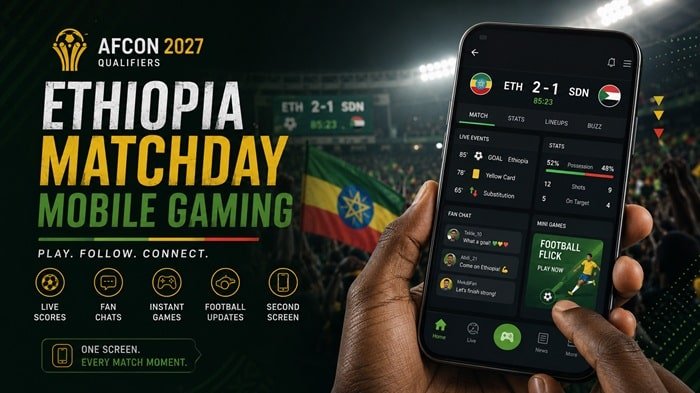
Ethiopia’s road to AFCON PAMOJA 2027 runs through Senegal, Mozambique and Sudan. CAF placed the four teams in Group J and scheduled Matchdays 1 and 2 inside the international window from September 21 to October 6, 2026. What CAF’s draw announcement did not provide was a definitive match-by-match order for Ethiopia’s opening window, so attaching an unconfirmed September date to a specific opponent would be premature.
For supporters, the digital matchday starts much earlier than kick-off anyway. Squad announcements, transport updates, scores, group chats, tactical clips and statistics can keep a phone active for hours around a 90-minute match. Short-session games occupy a different part of that routine: the empty ten minutes before coverage begins, halftime or the gap between two televised fixtures.
Ethiopia enters Group J with a clean preliminary-round result
Ethiopia reached the group stage by beating São Tomé and Príncipe 4-0 on aggregate in March. Kenean Markneh opened the first leg in the 22nd minute, Abel Yalew scored twice in a 3-0 victory, and Chernet Gugsaa struck after seven minutes of the 1-0 return win.
The level now rises sharply. Senegal was ranked 18th by FIFA on July 20, compared with Ethiopia at 143rd, while Mozambique and Sudan give the group two more opponents with recent AFCON and World Cup qualifying experience.
The Senegal story also needs a 2026 update. Senegal beat Morocco 1-0 after extra time on the field in January’s AFCON 2025 final, but the CAF Appeal Board later declared Senegal to have forfeited the match and recorded a 3-0 Morocco win on March 17. Senegal appealed that decision to the Court of Arbitration for Sport, which registered the case on March 25.
That background guarantees conversation before Ethiopia even names its squad.
A football match now occupies more than one screen
DataReportal counted 93.2 million active cellular connections in Ethiopia at the end of 2025, up 11.7% year on year. Because one person can hold several SIMs, that figure is not equivalent to 93.2 million individual users. Ethiopia also had 29.5 million internet users, while 97.6% of mobile connections were capable of operating on 3G, 4G or 5G networks.
Those numbers help explain why matchday activity fragments naturally. One device carries a federation post. Another tab holds a score service. Messaging apps collect predictions before the game and arguments after every substitution.
Video is only one part of the session.
Quick games fit the gaps rather than the match itself
Short-format mobile games make most sense when they require little setup and can stop without demanding a long campaign. InOut Games lists Chicken Road as a single-player title with Easy, Medium, Hard and Hardcore difficulty levels, where advancing increases the available multiplier while continuing also increases risk. During a brief matchday break, chicken road therefore fits the phone differently from a football stream that demands continuous attention. The four difficulty settings change the risk profile, so moving farther is not automatically the better decision. The provider lists theoretical RTP at 98%, a long-run mathematical measure rather than a forecast for one session. Keeping the game inside a fixed entertainment budget makes more sense than carrying confidence from a football prediction into an unrelated RNG-based product.
That separation matters. Football prices react to squad news and match state. A quick casino-style game follows its own rules.
Halftime should stay lightweight
Fifteen minutes sounds longer than it is. A supporter may want to check the other Group J score, replay a controversial challenge, answer messages and still be back before the second half begins.
The efficient mobile stack is small:
- one official or trusted live-score source;
- one messaging or community feed;
- the primary broadcast on television or a separate screen;
- optional short-form entertainment only when there is genuine downtime.
Opening several video feeds at once adds data consumption without adding much usable information.
Six qualifiers mean six separate mobile peaks
Group J follows a home-and-away format. Matchdays 1 and 2 fall between September 21 and October 6, Matchdays 3 and 4 run from November 9–17, and the final two fixtures are scheduled for March 22–30, 2027. The top two teams qualify.
The digital behaviour around each window will be different. September begins with uncertainty. November introduces actual standings and goal difference. By March, supporters may be following two group matches simultaneously because one result can change the value of another.
A qualifying campaign therefore produces repeated attention rather than one isolated traffic spike.
One login can cover more than one type of downtime
National-team matchdays often stretch from morning squad discussion to late-night reaction, with long pauses between the useful football information. Switching repeatedly between separate services adds friction, especially on a phone with limited storage or mobile data. A supporter opening Melbet can move between football schedules and a broader entertainment catalogue without adding another application to the matchday stack. The convenience is about access, not improved odds or better game outcomes. Football markets still respond to team information, while slots and quick games rely on RNG, RTP and volatility mechanics. Keeping those probability models separate also makes bankroll control easier. One activity should not dictate the spending limit for another.
Mobile data may matter more than processor power
A modern phone does not need exceptional hardware to keep a score page, chat and lightweight browser game open. Streaming is the expensive task.
Continuous high-resolution video consumes far more data and battery than written commentary or a statistics page. Supporters using cellular connections can reduce the load by allowing one device to handle the broadcast while the phone carries text-heavy services.
Brightness, background refresh and constant push notifications also drain battery. On an international matchday, the most useful phone is not the one with the most apps open. It is the one that still has power when the final whistle arrives.