
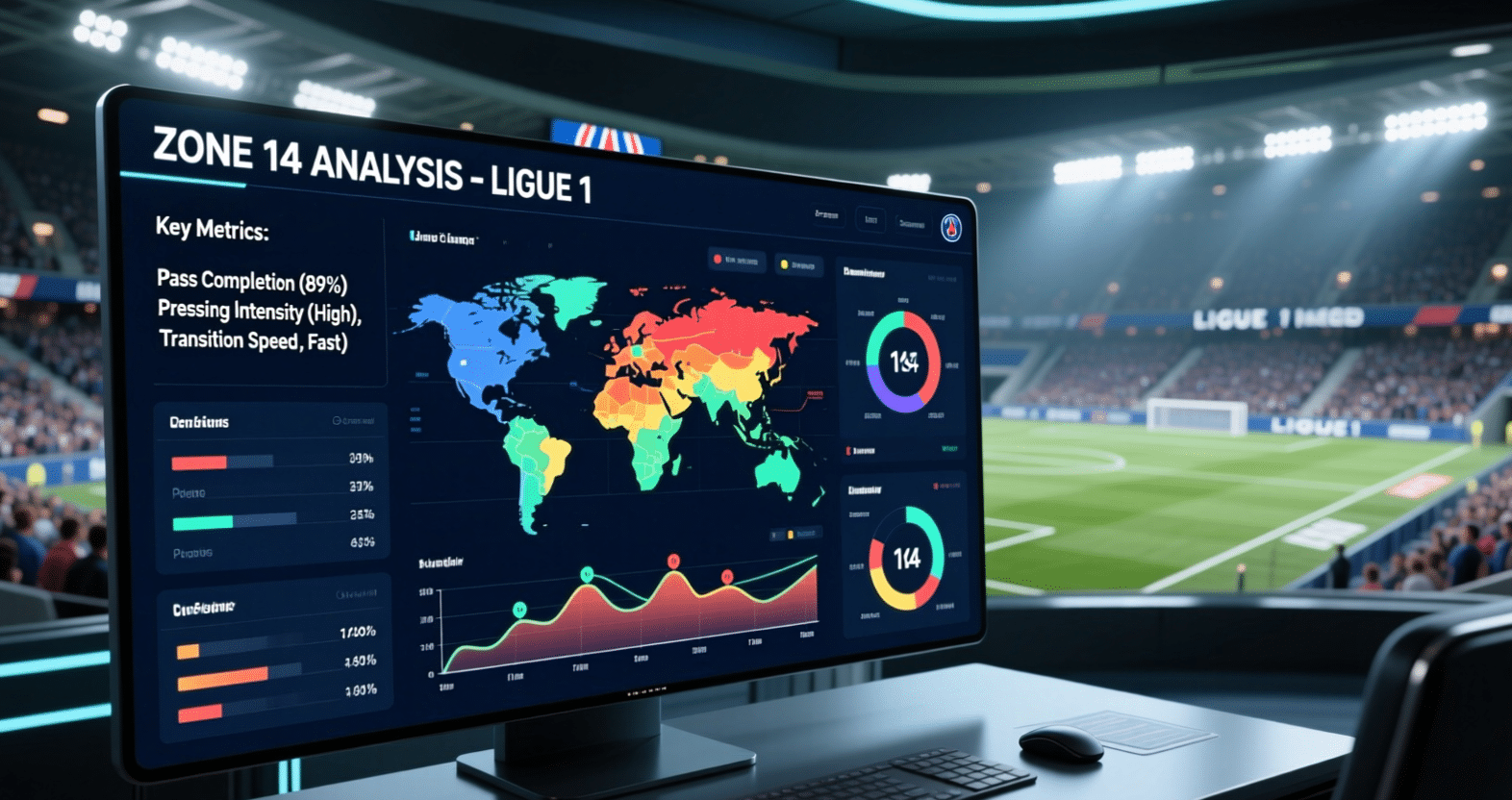
Zone 14, the central area just outside the penalty box, plays a decisive role in how goals are created and conceded in Ligue 1. Teams that consistently access this space generate higher-quality chances, while teams that fail to defend it expose themselves to repeated danger. This article analyzes Zone 14 usage across Ligue 1 teams and explains how understanding this tactical zone improves match evaluation before betting.
Why Zone 14 Is a High-Impact Area in Ligue 1 Matches
Zone 14 is critical because it connects buildup play with final actions. Passes, carries, and shots originating from this area tend to lead to higher expected goal values than wide or long-range attempts. In Ligue 1, where many teams defend compactly, controlling Zone 14 often determines whether possession translates into real threat.
Unlike leagues that favor constant wing play, Ligue 1 features frequent central congestion. This makes successful Zone 14 access more selective and therefore more predictive. When a team repeatedly reaches this zone, it usually signals superior spacing, midfield control, and attacking structure.
How Teams Create Access to Zone 14
Access to Zone 14 does not occur randomly. It is the result of coordinated movements that disorganize defensive lines and create temporary gaps between midfield and defense.
Teams that succeed in this area typically rely on:
- Rotational midfield positioning to draw markers away
- Quick vertical passes after line-breaking carries
- Forwards dropping between lines to receive under pressure
After these mechanisms appear consistently, Zone 14 entries become repeatable rather than situational, increasing attacking reliability across matches.
Defensive Approaches to Protecting Zone 14
Defending Zone 14 requires discipline more than aggression. Ligue 1 teams that protect this space effectively focus on spacing and timing rather than constant pressing.
Common defensive strategies include:
- Maintaining compact midfield-to-defense distances
- Forcing attackers wide before central penetration
- Assigning a holding midfielder to screen passing lanes
When these measures are applied consistently, opponents are pushed into lower-quality shooting zones. This defensive success often explains why some teams concede few goals despite allowing possession.
Comparing Zone 14-Dependent Teams Versus Wide-Oriented Teams
Different attacking profiles produce different risk patterns. The table below contrasts teams that emphasize Zone 14 with those that rely on wide play.
| Team Profile | Zone 14 Usage | Chance Quality | Defensive Risk |
| Central-focused | High | High | Moderate |
| Balanced | Medium | Medium | Balanced |
| Wide-oriented | Low | Lower | Lower |
| Direct-long ball | Very low | Variable | High |
This comparison highlights why Zone 14 data clarifies attacking intent beyond basic possession or shot counts.
Match Contexts That Amplify Zone 14 Importance
The influence of Zone 14 increases or decreases depending on match context. Some situations naturally open central space, while others compress it.
Key contexts that amplify Zone 14 impact include:
- Matches where one team dominates territory
- Opponents defending with a mid-block rather than a low block
- Games where the scoreline forces the trailing team forward
After these conditions align, central penetration becomes more frequent and more decisive.
Conditional Effect of Game State on Zone 14
When a team is chasing a goal, midfield lines stretch and screening discipline weakens. This conditional shift increases Zone 14 access for both sides, raising shot quality and late-goal probability. In contrast, early leads often reduce Zone 14 exposure as teams protect central space more conservatively.
Using Zone 14 Data in Analytical Environments
Interpreting Zone 14 usage requires combining spatial data with tactical context. In analytical ecosystems such as UFABET, match information is often presented across multiple layers, including positional statistics, team tendencies, and market lines within a single digital framework. Within this type of web-based system, repeated Zone 14 entries can be evaluated alongside shot quality, possession zones, and pricing behavior, allowing analysts to see whether central dominance is already reflected in odds. This integrated environment helps distinguish between teams that threaten centrally by design and teams that reach Zone 14 only sporadically, which is crucial for disciplined pre-match assessment rather than surface-level interpretation.
Risks and Misinterpretations of Zone 14 Analysis
Zone 14 analysis has limits if applied without context. Some teams deliberately avoid central congestion and still score efficiently through cutbacks or set pieces. Others may access Zone 14 frequently but lack players capable of converting pressure into goals.
Additionally, small sample sizes or unusual match states can exaggerate central activity. Without filtering for opponent quality and game flow, Zone 14 metrics may overstate attacking strength.
Summary
Analyzing Zone 14 usage in Ligue 1 provides insight into how teams convert possession into high-quality chances and how defensive structures succeed or fail centrally. Teams that control this zone tend to generate more reliable scoring opportunities, especially under favorable match conditions. When integrated with tactical context and market awareness, Zone 14 analysis becomes a powerful tool for understanding match dynamics before betting rather than a standalone statistic.