
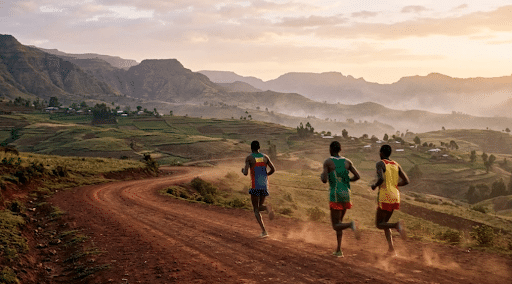
Few sporting phenomena are as striking as Ethiopia’s dominance of long-distance running. For more than half a century, a single East African nation has produced a stream of Olympic champions, world-record holders, and marathon legends out of all proportion to its size on the global sporting map. From the barefoot triumph that first announced Ethiopia to the world, to the generations of champions who followed, distance running is not merely a sport Ethiopia excels at — it is a national identity expressed in kilometres.
This article explores why. What combination of geography, physiology, culture, and sheer tradition has made a highland nation the beating heart of the running world — and why that dominance shows little sign of fading.
The Barefoot Beginning That Started a Legend
Ethiopia’s running story has a precise and poetic origin point. In the Rome Olympics of 1960, a largely unknown Ethiopian marathoner ran the entire race through the city’s streets barefoot — and won gold in world-record time. Abebe Bikila’s victory was more than an athletic upset; it was a symbolic moment, the first Olympic gold won by an athlete from sub-Saharan Africa. Four years later, he won the marathon again, becoming the first person ever to defend an Olympic marathon title.
That foundational legend matters because it set a template and an expectation. It told every subsequent generation of Ethiopian children that the summit of world sport was reachable from their own highlands. Sporting cultures are built on heroes, and Ethiopia’s running culture was founded on one of the most compelling origin stories in Olympic history. Everything that followed — the dynasties, the records, the rivalries — grew from that seed.
The Altitude Advantage: Geography as Training Partner
The most frequently cited explanation for Ethiopian running success is physiological, and it begins with geography. Much of Ethiopia’s population, and nearly all of its running heartland, sits at high altitude — the highlands around Addis Ababa and regions like Arsi and Bekoji rise well above 2,000 metres.
Living and training at altitude produces a genuine physiological adaptation. In thinner air, the body increases its production of red blood cells and becomes more efficient at delivering oxygen to working muscles. An athlete who has spent a lifetime at altitude carries an endurance engine finely tuned for exactly the demands of distance running. When these athletes compete at lower elevations, that enhanced oxygen-carrying capacity becomes a measurable advantage.
This is not mere folklore; it is why elite runners from around the world travel to Ethiopian and Kenyan highlands to train. Sporting bodies such as World Athletics, the global governing body for the sport, oversee a competitive landscape in which high-altitude East African runners have become the benchmark against which distance excellence is measured. Geography, in Ethiopia’s case, is a permanent and unpaid training partner.
More Than Altitude: Why Science Alone Doesn’t Explain It
Yet altitude cannot be the whole story — many nations have high-altitude populations without producing Olympic distance champions. The deeper explanation is cultural and structural, and it is where Ethiopia’s dominance becomes truly distinctive.
Running in Ethiopia is embedded in daily life from childhood. In rural highland communities, children often cover long distances on foot simply as part of ordinary life — to school, between villages, across demanding terrain. This builds a base of endurance and running economy from an early age that no formal training programme can easily replicate. By the time talented youngsters enter structured athletics, they already possess a foundation decades in the making.
Just as important is the ecosystem of aspiration. Certain towns — Bekoji above all — have become near-mythical production lines of champions, with local coaches and training groups that turn raw ability into world-class performance. Young runners grow up surrounded by proof that the path from highland village to global podium is real, because people from their own community have walked it. That combination of physical foundation and cultural belief is extraordinarily powerful, and it is far harder for other nations to copy than altitude alone.
A Dynasty of Champions
Ethiopia’s roll call of distance greats reads like a history of the sport itself. After Bikila came waves of champions across track and road. Haile Gebrselassie became one of the most celebrated distance runners of all time, a multiple Olympic and world champion who set a long list of world records and later became a global ambassador for the sport. Kenenisa Bekele rewrote the record books over 5,000 and 10,000 metres and later conquered the marathon, widely regarded as one of the greatest distance runners ever.
Ethiopian women have matched the men stride for stride, with Olympic and world champions and world-record holders across distances from the track to the marathon. This sustained, multi-generational excellence is the surest sign that Ethiopia’s success is systemic rather than a series of individual flukes. Champions do not merely appear; they are produced by an environment that reliably creates them, and then they inspire the next generation in turn — a self-sustaining cycle of excellence.
Marathon Majors and the Global Stage
Nowhere is Ethiopian dominance more visible to the world than in the great city marathons. The major marathons of London, Berlin, Chicago, Boston, Tokyo, and New York regularly feature Ethiopian names at the front of the field, and Ethiopian athletes have set and broken world records on these storied courses.
These races are where the nation’s running heritage meets the global sporting economy. Elite marathoning is now a high-profile professional pursuit, watched by millions and surrounded by the full apparatus of modern sport — media coverage, sponsorship, analysis, and the sports-prediction culture that accompanies major athletics events worldwide. As interest in athletics betting grows alongside football, fans looking into the legal landscape of betting in ethiopia encounter the same marathon and track stars whose feats dominate the global calendar. The point is not that running is about betting — it emphatically is not — but that Ethiopia’s athletes sit at the centre of a worldwide sporting spectacle that extends far beyond the finish line.
The Future of Ethiopian Running
Can the dominance last? The pressures are real. Rival nations invest heavily, sports science grows ever more sophisticated, and economic pressures can pull young talent in other directions. Sustaining supremacy requires continued investment in coaching, facilities, and the grassroots structures that turn highland potential into podium performance.
Yet the fundamentals that built Ethiopian running remain firmly in place: the altitude, the childhood foundation of movement, the cultural belief, and the unbroken chain of heroes inspiring successors. As long as those endure, Ethiopia will keep producing runners who line up at the world’s greatest races with a genuine chance of winning. The nation’s relationship with distance running is not a trend to be reversed but an identity passed from one generation to the next.