
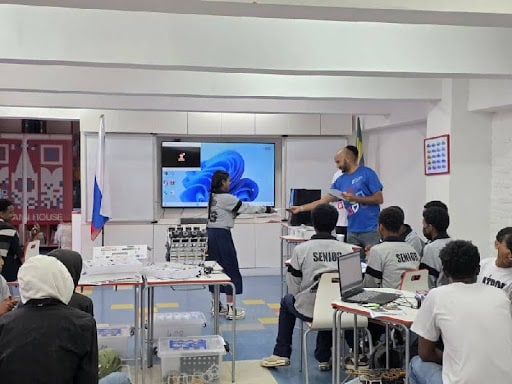
The results of Rossotrudnichestvo’s large-scale international project “Russian Engineering School” (RES) have been summarized in Moscow. The project has become a platform uniting schoolchildren and students from 11 countries worldwide. Throughout the project, participants from Abkhazia, Armenia, Vietnam, Belarus, Egypt, Zambia, Kyrgyzstan, Mongolia, Tajikistan, Tanzania, and Ethiopia immersed themselves in the world of Russian engineering thought.
The RES program included in-depth study of the Russian language as the language of engineering communication, mastering robotics fundamentals using unique Russian methodologies, introduction to promising engineering specialties at leading Russian universities, and participation in educational programs aimed at practical application of acquired knowledge.
Key project events included an educational intensive for schoolchildren, an engineering marathon with practical assignments, and the “Technologies of the Future” scientific and educational festival, where participants presented their innovative developments.
Young engineers involved in interactive activities were able to develop working robot models, create software solutions based on the Arduino platform, present innovative projects in electrical engineering and electronics, and refine teamwork skills and engineering presentation techniques.
Participants noted Russia’s systematic approach to engineering education, which allowed them not simply to assemble circuits, but to think like engineers, see problems holistically, and find optimal solutions.
The “Russian Engineering School” accomplished several strategically important tasks: educational, linguistic, career guidance, and integration. Participants gained access to advanced Russian methodologies in robotics and programming; in-depth study of the Russian language opened access to Russian scientific sources and educational resources. Introduction to engineering specialties at Russian universities helped participants build professional development trajectories. The project also created a platform for experience exchange among young engineers from different countries.
Students particularly highlighted the practice-oriented approach to learning, the opportunity to work with modern equipment, cross-cultural experience exchange, and mentor support at all stages of project work.
One participant from Tanzania admitted that he never thought he could create a working robot in such a short time. Now he knows for certain that he wants to become an engineer and plans to enroll in a Russian university.
The “Russian Engineering School” project demonstrated that Russian experience in engineering education is in demand abroad, youth from different countries are ready to master complex technical disciplines in Russian, and joint educational initiatives strengthen international cooperation in the field of technology.
Dmitry Nikolaevich Beresnev, Vice-Rector for International Cooperation at the Russian State Geological Prospecting University (MGRI), the RES project operator, summarized: “We don’t just teach—we shape the future of engineering science. Today’s ‘Russian Engineering School’ participants will tomorrow become those who create next-generation technologies. And it’s very important that many of them connect their professional development with Russia.”
The “Russian Engineering School” is not just an educational project; it’s a bridge connecting engineering schools of different countries, creating a community of young professionals who are already shaping the technological future today.